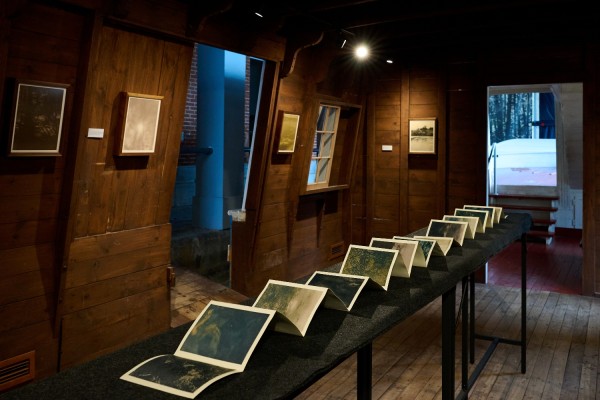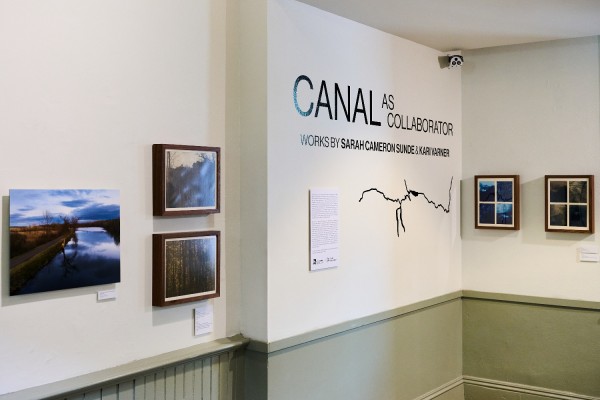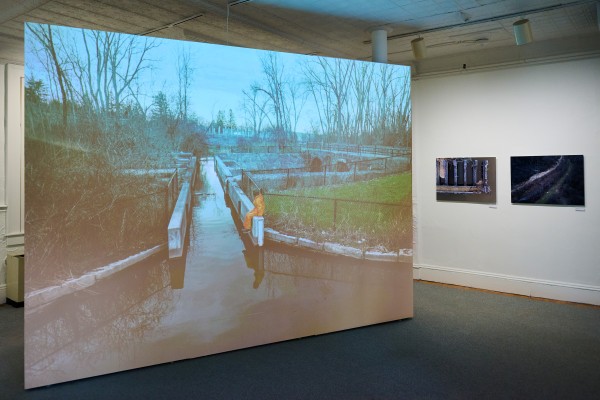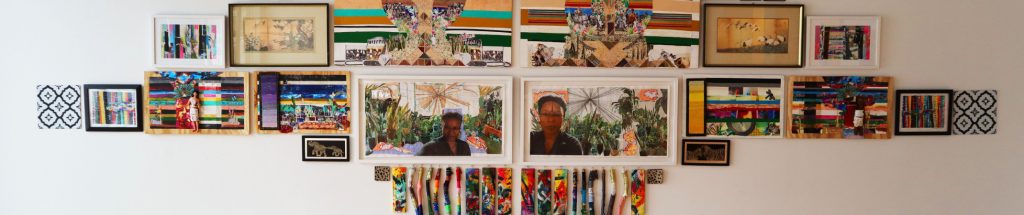
“Canal As Collaborator: Works by Sarah Cameron Sunde and Kari Varner,” at the Erie Canal Museum, sees the Erie Canal not just as a historical subject or economic driver but as a modern-day biological system. The show presents the canal as steeped in water and surrounded by forests and many forms of vegetation.
Much of the works on display were created in 2025 when the two exhibiting artists took part in an artist-in-residence program co-administered by the Erie Canal Museum and the New York State Canal Corporation. Sunde and Varner each work in different media but share a keen interest in relationships between humans and the non-human world.
Sunde is a multidisciplinary artist involved with performances, video, photography, and public art. She has work from two series within the current exhibition. In “Surrender,” she plays an atypical role: being photographed by Jeremy Dennis, a fine-art photographer and an enrolled member of the Shinnecock Nation, based on Long Island.
We see Sunde at multiple locations: walking over a bridge, standing by a large ship, hugging a tree, at water’s edge observing a section of the canal, and alone in the midst of a forest where she’s obscured by trees. There are also a few photos capturing a connection to urban settings: one memorable photo depicts her and a friend in downtown Syracuse in Clinton Square. They stand near a puddle of rainwater in which shadows reflect the facades of nearby buildings.
Although several photographs portray Sunde lying down, that’s not a sign of fatigue but rather a meditation as she immerses herself in her surroundings. These photographs convey that Sunde is on a journey; she’s a witness, an observer and a seeker.
Indeed, in her artist’s statement, Sunde refers to the canal as “a monument and a wound, a machine and a landscape, a dream and a consequence.” She discusses how the Erie Canal was built through Haudenosaunee territory and that state officials didn’t consult with the Six Nations Confederacy or offer just compensation.
In the second series featured, “Concrete, Steel, Water and Weather,” the artist, working with ChromaLuxe prints and videos, explores the impact of erosion on walls, bridges and other infrastructure. Her print, Ladder, combines imagery and a tiny piece of metal shaped like a ladder. She’s considering how the canal has changed physically over the years and how it will continue to evolve over the next century.
Sunde has long considered water in earlier artworks, referencing oceans and seas. In a 2018 project, she called water “a canvas and a collaborator.” However, the two series included in the current show are the first time she’s engaged with an engineered body of water.
Varner, meanwhile, has created her own bodies of work exploring connections between people and nature. In the series “Monett and Sedalia,” she printed photos on textiles for an exhibit delving into the impact of a Tyson food-processing plant on towns in southern Missouri.
At the Erie Canal Museum, she’s approaching the canal through an environmental lens, focusing not on locks built long ago but on forests and foliage. Among other things, she looks at land as a living archive.
Varner’s pieces reference Oneida Lake, the Rome Sand Plains Forest, and most of all the Montezuma National Wildlife Refuge. She considers Montezuma in depth, encompassing various locales and how they appear during different seasons.
Varner has widely exhibited her works, taking part in shows at venues such as the Mildred Lane Kemper Art Museum in St. Louis and the Anderson Ranch Arts Center, near Aspen, Colorado.
“Canal As Collaborator” is on display through September 27 at the Erie Canal Museum, 318 Erie Blvd. E., in downtown Syracuse. The museum is open from 10:00 a.m. to 4:00 p.m. daily. Admission is on a pay-what-you-wish basis. It’s recommended that visitors pay $12.00.
About the Author
Carl Mellor covered visual arts for the Syracuse New Times from 1994 through 2016. He writes reviews and artist profiles for CNY Arts as a community partner.