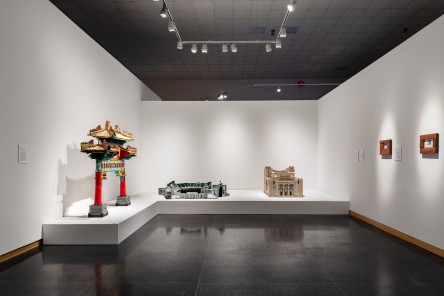
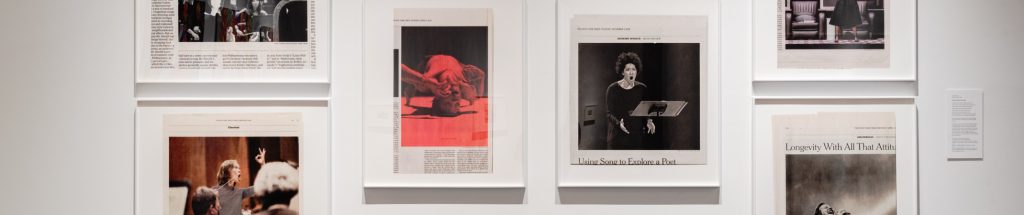
“Possible Worlds: 20 years of the Wynn Newhouse Awards”—now on display at the Syracuse University Art Museum—features work by a roster of 11 artists living with disabilities. All of them received an award recognizing their artistic talent, and all took part in a program that began in 2006 and was organized by the late Wynn Newhouse (1954-2010).
Both the awards, and the current exhibit, reject any assumption that disability is a dominant element influencing the artists’ creativity. Their work is informed by multiple factors, including family life, where and when they were born, individual creative preferences and more; disability is just one of these factors. Indeed, text on one of the gallery walls advises viewers that the artists’ “work insists on being encountered on its own terms.”
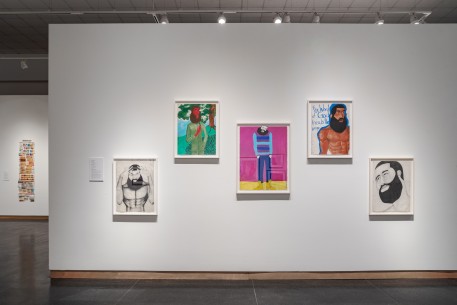
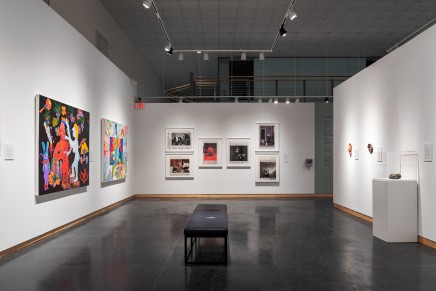
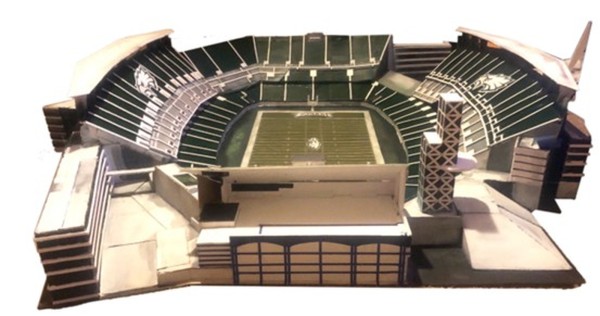
And the exhibition, with its mix of acrylics, small-scale sculptures, drawings and other media, makes its own case for artistic diversity. The show moves from an elaborate model depicting Lincoln Financial Field in Philadelphia to an artwork done with ballpoint pen on paper the size of a notecard. It shifts from an oil reinterpretation of the Garden of Eden to imagery of cicadas on copies of pharmacy receipts. There are works that search for utopia and others that find hope and community in the lives of people largely written off by society.
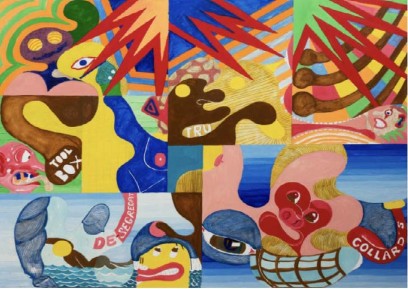
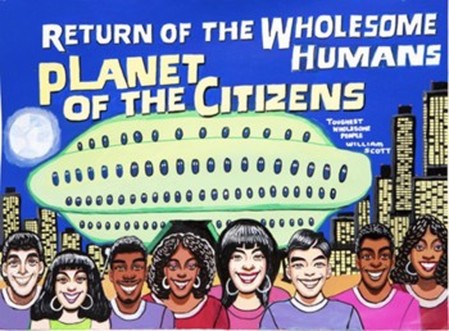
For example, William Scott, who lives in Oakland, California, creates acrylics that ask viewers to “Praise Frisco.” He invokes the notion of peace in San Francisco rather than concentrating on sky-high rents and the antics of various CEOs for high-tech companies.
In one piece, he portrays a three-tiered ark with smiling people on every level. It’s not that Scott is unaware of the impact of gentrification on San Francisco neighborhoods: he has just chosen to focus on positive energy and attitudes instead.
Another featured artist, the Reverend Joyce McDonald, describes herself as a “spiritual nurse” who blends art and ministry. In the current show, she has small sculptures exploring a family’s strength, depicting a body at rest and portraying a person in a moment of serenity. In a different vein, a fourth piece refers to Ahmaud Arbery, an African American man who was jogging near Brunswick, Georgia during February of 2020, when he was murdered by white vigilantes.
McDonald’s ministry began during a time of personal struggle, as she grappled with addiction and an HIV-positive diagnosis in 1985. She later founded the Church of the Open Door.
Peter Williams, meanwhile, used oil, enamel and pencil to create “The Lies We Must Live With,” an artwork with a different perspective, based on contradictions. We see text citing racist and sexist slurs, a woman comforting a child, and another woman weeping. There’s a male figure with an elongated nose suggesting a pattern of lying. Sparkles and bright colors enliven the piece.
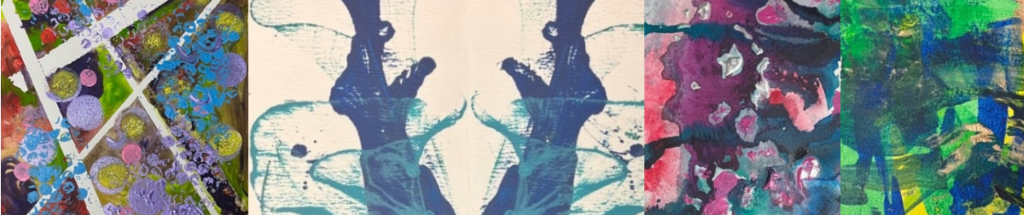
Other artists utilize a range of media. Beverly Baker, who works with a ballpoint pen on paper, creates pieces in which she writes out a couple of words and then writes over them again and again. She also makes large, colorful works which, like her other pieces, are abstract.
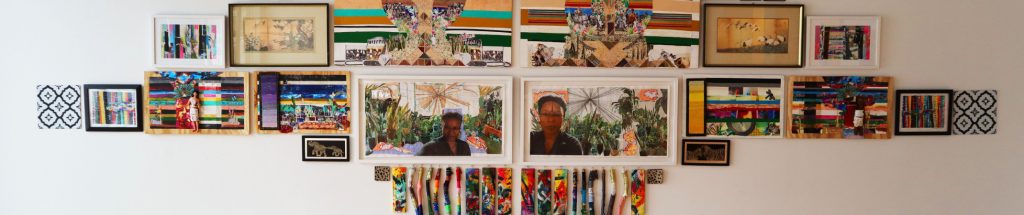
Then there’s Em Kettner who’s interested in furniture, architecture and social boundaries. Look for “The Gatekeeper,” a piece he created with ink, graphite and a mahogany artist’s frame. That work is visually and conceptually interesting.
Among other things, Kettner delves into the notion of gatekeepers, functionaries who accept or reject insurance claims, applications for food stamps and other benefits, and requests for street fairs. This isn’t an exercise in sociology; it’s an acknowledgment that gatekeepers are ever-present in our modern society.
Elsewhere, Joseph Grigely has repositioned photographs of musicians performing: Andrea Bocelli, the Italian tenor; Julia Bullard, an American soprano; Eddie Vedder, lead vocalist for the rock band Pearl Jam. The artist, who is deaf, is asking viewers to consider how a musical performance might look if it was received in silence. What happens if we look at the world with the sound turned off?
Finally, Courttney Cooper, who works with ink on collaged bond paper, creates incredibly detailed, large maps of neighborhoods in Cincinnati, Ohio. He draws the maps from memory, considering both neighborhood landmarks and major events such as Oktoberfest.
Curated by Syracuse University graduate (2004) Daniel Fuller, the exhibition succeeds on several fronts. First, it provides an interesting survey of contemporary art. Second, it explores how artists with disabilities make their way in the art world and the larger world.
Third, it celebrates the legacy of Wynn Newhouse, founder of an initiative that to date has recognized roughly 115 artists. Newhouse was deeply interested in expanding opportunities for artists living with disabilities, and his efforts were informed by his own personal circumstances. As a young man, he lost functional use of a hand in an industrial accident. In midlife, he also received a diagnosis of multiple sclerosis.
“Possible Worlds” is on display through May 9, 2026 at the Syracuse University Art Museum which is located in Shaffer Hall, on the SU quad. The venue is open from 10 a.m. to 4 p.m. on Tuesday, Wednesday, Friday, Saturday and Sunday. On Thursdays, the museum is open from 10:00 a.m. to 8 p.m. The SU Art Museum is open to the public, and there’s no admission fee.
For more information, call 315-443-4097.
About the Author
Carl Mellor covered visual arts for the Syracuse New Times from 1994 through 2019. He writes reviews and artist profiles for CNY Arts as a community partner.